Anthropic Has a Business Model Problem
It moved up the stack. Its monetization didn’t.

Claude is an impressive product. And it’s received well-deserved recognition in recent months. It became the go-to for coders and knowledge workers alike, moving upmarket from delivering basic replies to acting for users. This is the result of deep product innovation and enterprise focus.
But, despite its rapid product evolution, it’s still stuck with a token-based business model. What made it successful won’t get it to the next era. Its business model needs to evolve to match the efficiency it delivers.
How it started
Anthropic’s original business model made sense for the company it used to be. It was enterprise-focused, developer-oriented, and much of Claude’s value was sold as model access through APIs, usage caps, and compute-shaped plans. Claude often sat behind the scenes as the infrastructure layer powering coding products like Cursor rather than as the front-end software purchase itself. In that world, API pricing. The knowledge-worker chatbot was a smaller part of the story, so a capped subscription sufficed.
The actual usage limits tied back to tokens. More compute-intensive and accurate models (Opus) burned down capacity faster. Lighter-weight, less precise models (Haiku) burned down capacity slower. Highly tied to inputs, and indirectly tied to outputs since costlier models and reasoning burn usage faster, but deliver better responses.
That model also shaped the business. The Information reported Anthropic forecast 80% of 2025 revenue to come from API sales. The company had more than 300,000 business customers by late 2025 and that roughly 80% of revenue came from those customers. Claude Code alone had reached nearly a $1 billion annualized revenue run rate.
Then the product evolved
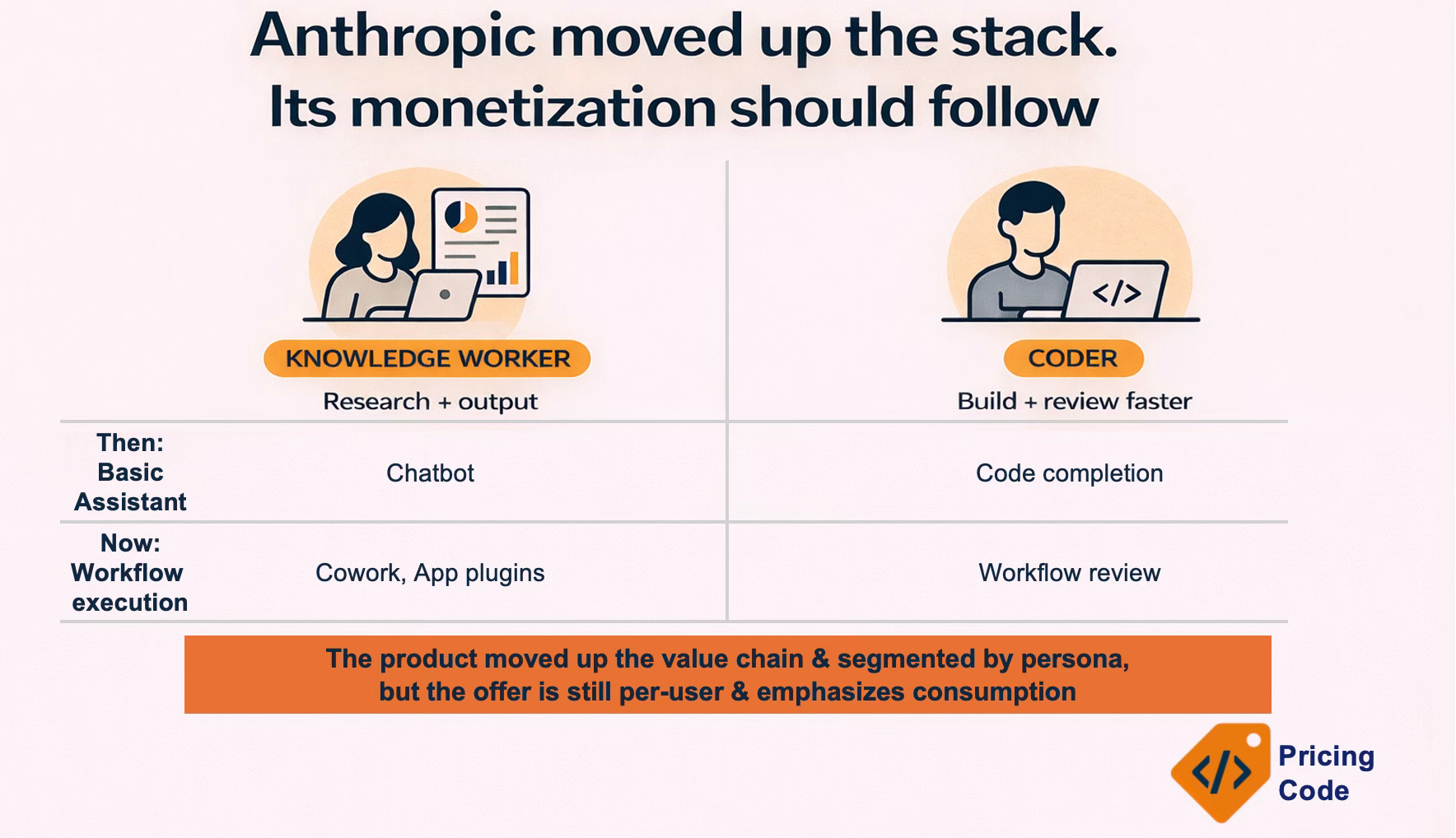
Claude evolved into two clearer products targeted at coders and knowledge workers. In both cases, the value moved up a layer: from answering questions to helping users execute work:
For coders, Anthropic moved from backend model access to a front-facing UX with Claude Code. It also moved further into a coder’s workflow, delivering reviews of its automated code via Code Review.
For knowledge workers, it’s built out its chatbot with integrations and skills to customize the experience to a user’s environment. It also started executing for knowledge workers with Cowork and plugins in Excel and PowerPoint.
But completing a workflow isn’t the same as answering questions. The latter saves an hour or so of an entry-level worker’s time. The former saves a few hours’ worth of a senior employee’s time. That lower cost lets a user apply more effort to lower-ROI projects that didn’t deserve prioritization before - Jevon’s paradox.
The business model retrenched on usage
That is where the business model starts to look dated.
Anthropic still pushes both personas through one broad subscription shaped mainly by usage caps. Max is sold as 5x or 20x more usage than Pro. The only other value a “Max” user gets is early feature access. It describes its value in hours of use with a given model: a value metric that doesn’t compute for knowledge workers and is too far from outcomes for coders.
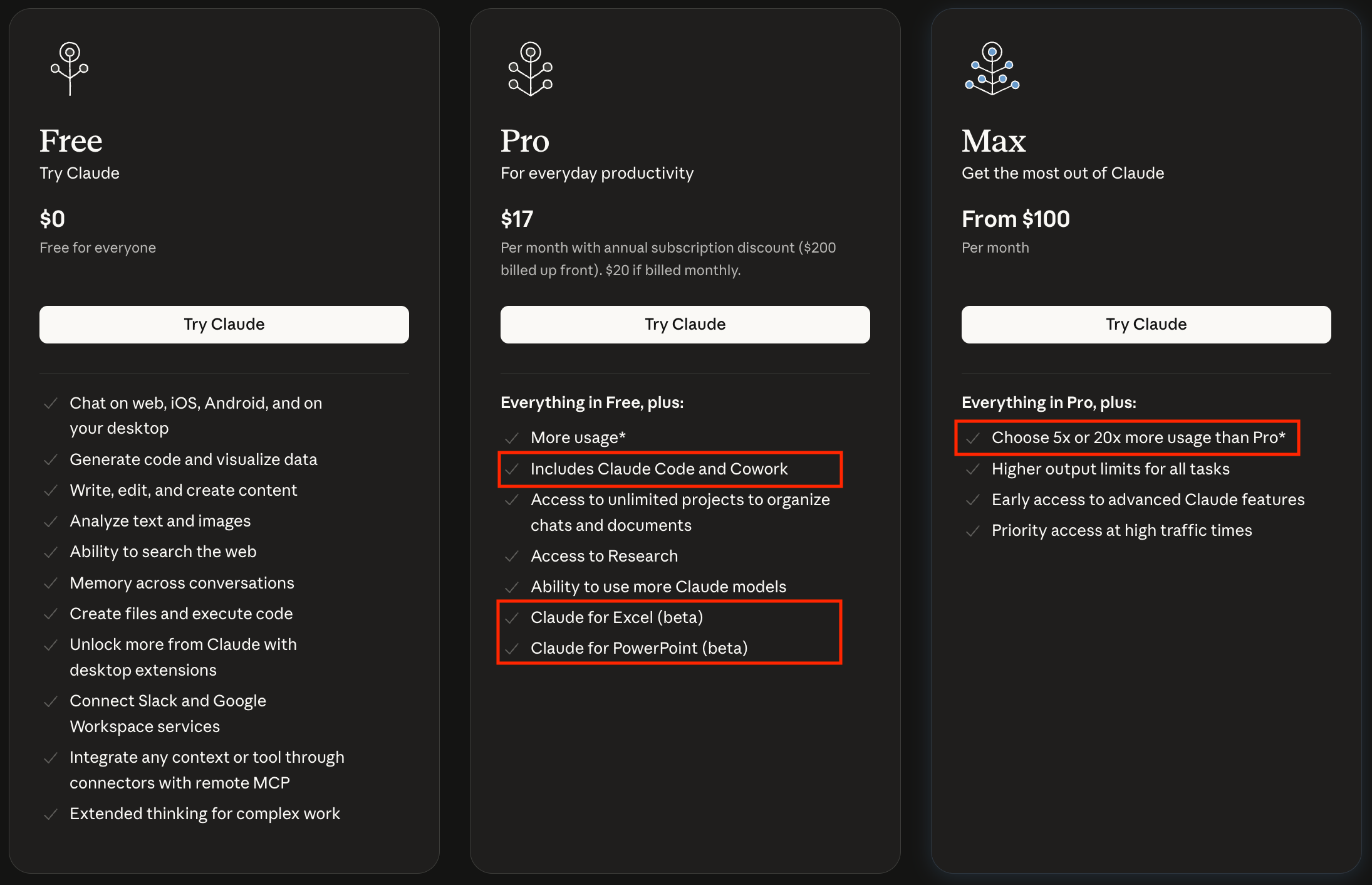
Anthropic’s individual pricing page. Core product differentiators are all in Pro; Max differentiates mainly on its higher usage limit.
For pure coders using the API alone, raw token costs don’t capture true value either. Code Review, one of its highest-value developer workflows so far, is still billed on token usage at $15–25 per review. That logic made sense when Claude was mainly infrastructure, but Code Review is valuable IP. Monetizing on credits alone undersells its incremental value.
The mismatch is becoming more visible because Claude is increasingly popular on its own merits. Ramp’s March 2026 AI Index says 24% of businesses now pay for Anthropic, up from one in 25 a year ago. Anthropic adoption grew 5% month over month, while OpenAI fell 2%.
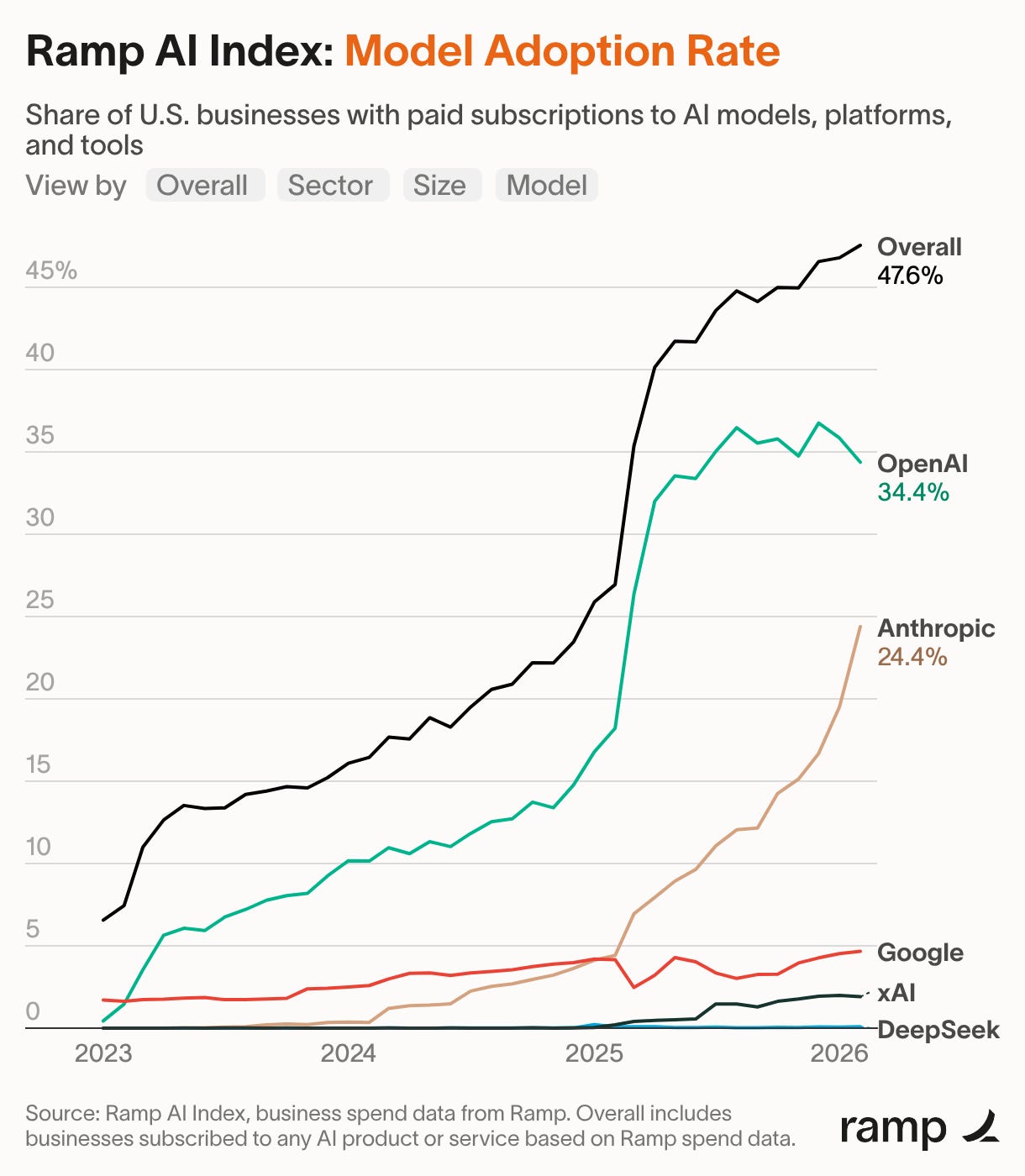
Credit: Ramp AI index
So why keep leaning on APIs? Part of the answer is likely sticking to what they know. They may expect the user base to converge. And they may be concerned about the economics. The Information reported Anthropic lowered its gross margin projection to 40% due to higher-than-expected inference costs. APIs, caps, and metered overages help protect scarce capacity and keep pricing aligned with volatile inference costs.
The business model needs to evolve
Claude will soon be held back by its business model. The cutting-edge companies that know about and use Claude today, and the heavy users within them, are atypical. They’ll experiment, be frustrated, and blur the user persona line more than the average user who’s still marveling at ChatGPT’s ability to draft e-mails. Their procurement team is much more skeptical.
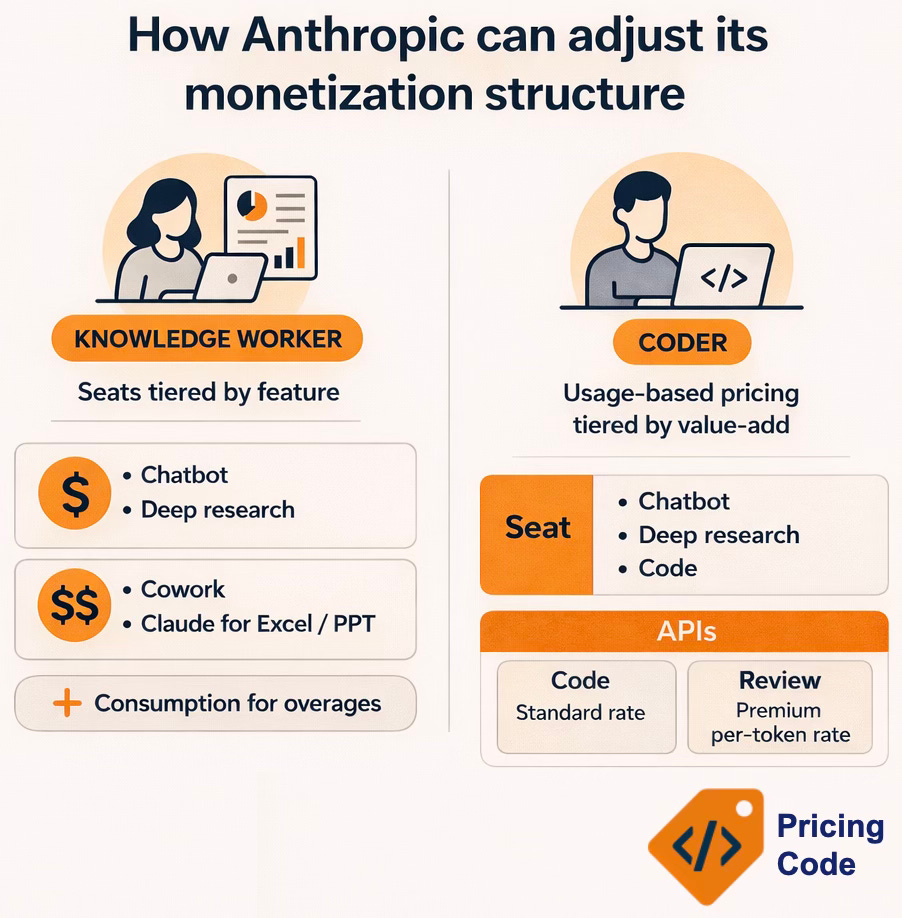
This means the business model needs to evolve to cater to specific personas and give users the predictability they need. A better long-term model would segment the product more cleanly:
A developer subscription with premium workflows like Code Review on top, either reserved for a specific tier or available at a premium per-token or per-checkpoint rate.
A knowledge-work seat built on unique IP like Cowork and Claude for Copilot, not just token consumption. Cowork, Research, and office tools like Excel and PowerPoint can be tiered into different offerings, giving clear use cases and value. And usage caps that degrade service, rather than shut access off for 5 hours unless you pay for tokens.
Change isn’t easy, as OpenAI is discovering with its move to an ad-based model. But as OpenAI showed, the longer you stick with the wrong model, the more painful the adjustment.
If Claude is moving up the value chain, its monetization should too.