
HubSpot vs. the AI Storm
How a SaaS Incumbent is Rewriting Its Business Model

If you want to see a SaaS player navigate AI disruption, watch HubSpot.
Few companies are closer to the AI blast radius: its software powers the same marketing, sales, and service teams that AI is coming for first. AI-powered upstarts like Gong are trying to unseat them as the place work happens. But they’re also adapting and fighting back – through business model and product.
From the SaaS transition to the AI revolution
Ten years ago, the big transition was on‑premise to SaaS. Adobe and Microsoft survived and thrived in two very different ways.
Adobe did a hard shift: it pivoted Creative Suite to Creative Cloud almost overnight, and its Digital Media (Creative + Document Cloud) revenue fell around 8% as perpetual licenses cratered. But the rebound was fast: Creative Cloud ARR grew more than 40% annually for the next two years.
Microsoft managed the move: in its Productivity & Business Processes segment (home to Office), revenue still grew 3–5% annually during the heaviest part of the migration, then accelerated into low double‑digit growth once commercial Office 365 crossed critical mass.
Both made it out of the shift and became role models for others. AI forces a similar question – how, and how quickly, to adapt – but the stakes are bigger. It isn’t just a shift from one type of seat to another; it’s about who does the work and how you capture that value. HubSpot is one of the clearest examples of a managed transition in progress.
HubSpot in the line of fire
HubSpot is a SaaS CRM platform spanning Marketing, Sales, Service, Content, Commerce, and Data Hubs, all sitting on its Smart CRM. It’s both the business context (where customer data and history live) and the work surface (where campaigns, deals, and tickets get executed).
That makes AI a direct threat. If AI can generate content, score leads, summarize calls, and resolve tickets, the work layer risks shifting away from the CRM. Tasks long anchored inside HubSpot’s hubs can be automated or shifted to tools like ChatGPT or Gong. And if work moves elsewhere, seat‑based SaaS models weaken.
But HubSpot also holds the ingredients AI needs: customer data, history, workflows, and permissions. The opportunity is to pull AI into the CRM so HubSpot remains where insights turn into action. That’s why they reframed the stack: hubs as human workspaces, core seats as the control point for shaping context, and agents to act on behalf of users. HubSpot has woven AI directly into the platform — keeping more actions inside the CRM and ensuring that even when AI does the work, it still runs through HubSpot.
HubSpot’s AI model: seats, assists, and credits
HubSpot’s AI business model rests on three pillars that line up cleanly with how customers already buy SaaS:
Upselling users on core seats, which have become the essential license for data and AI access. This creates a natural pull for free read‑only users to upgrade.
Making role-specific persona seats more valuable through embedded AI assists, which enhance sales and service reps’ work with summaries, action extraction, suggested replies, and deal or ticket insights.
Using AI consumption credits to meter work done on a user’s behalf, allowing automated agents to resolve tickets, run prospecting, or execute data workflows, with included credit pools for light usage and paid packs for scaled automation.
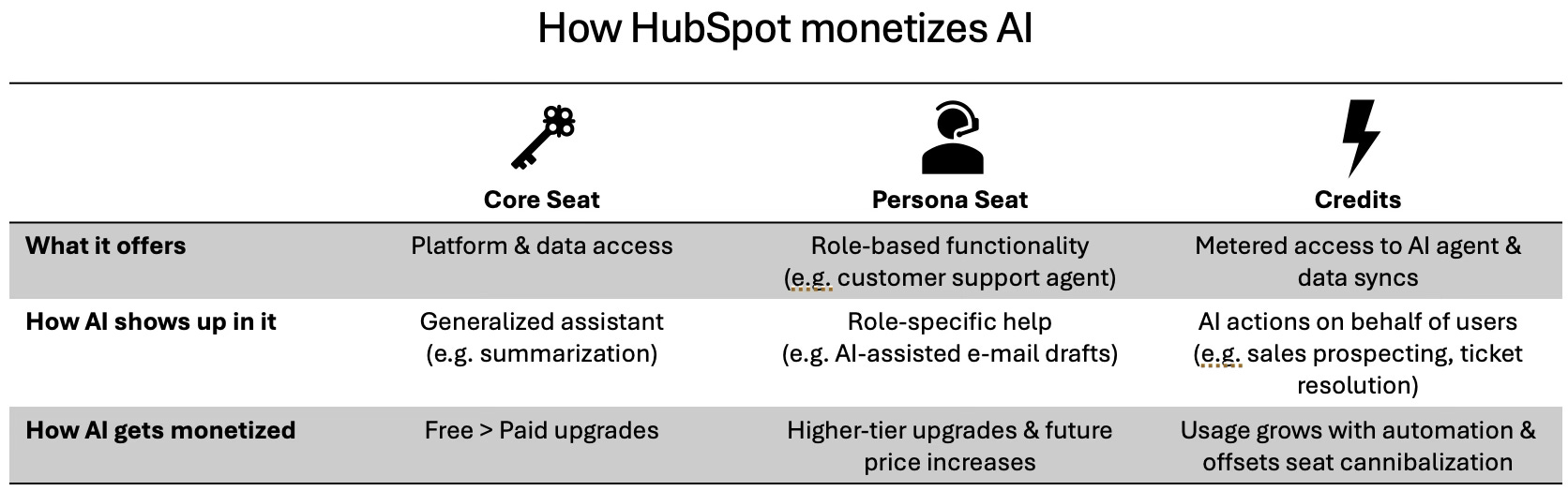
This model matches the product’s AI-first nature, charging companies on how, and how much, value they get from AI. They drive up seat value for user-assist AI, and capture value companies get as they automate their work. It also offsets seat-based cannibalization - a great example of aligning price to value.
Graduating AI services to credits – and early traction
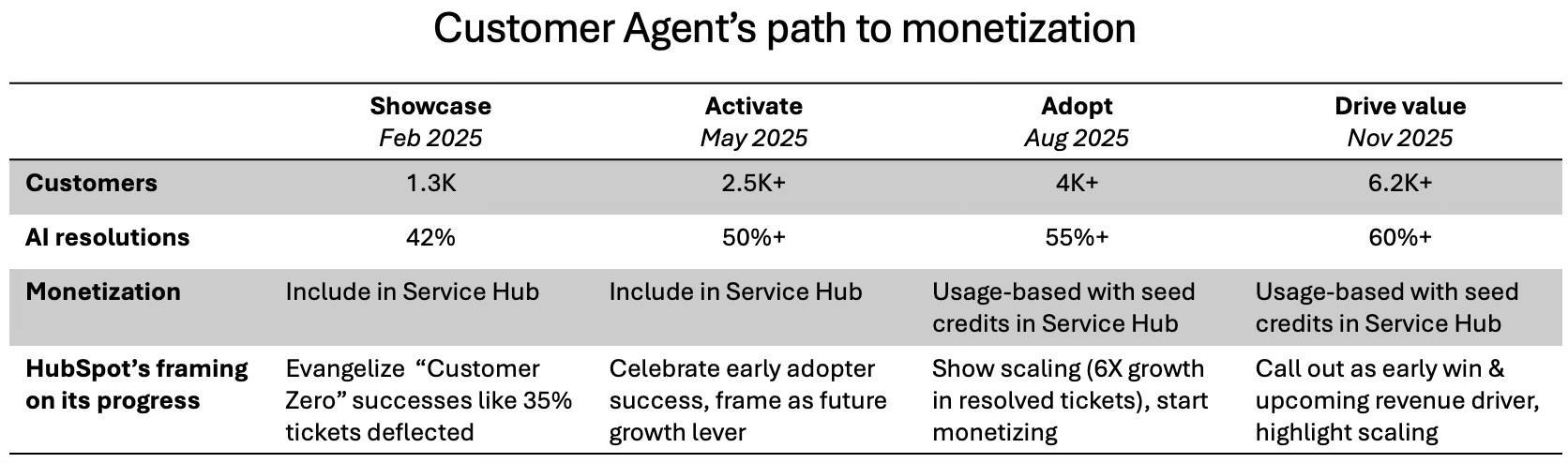
The other half of the story is how HubSpot decides when something moves from “included” AI to metered AI. The pattern so far is consistent: activate broadly, prove value, then monetize.
Take Customer Agent. It started as a way for Service Hub customers to deflect tickets and speed up response times. HubSpot moved from discussing its potential to sharing early wins to monetizing. Only after that traction was clear did HubSpot standardize Customer Agent on universal credits and present it as a long‑term growth lever.
A similar graduation is happening with Prospecting Agent and data agents. Sales teams can use AI to monitor intent signals, research accounts, and send first‑touch outreach. Once that becomes part of the daily rhythm for thousands of reps — not just an experiment in a handful of accounts — the incremental volume is what justifies additional credits.
Importantly, HubSpot is explicit that AI isn’t yet a material revenue driver. But this gradual adoption shows they’re managing the transition. It’s a contrast to Salesforce, which made a number of big branded AI launches with explicit charges, before making a number of high-profile walk-backs.
What to watch next
HubSpot is clear that AI is not yet a meaningful standalone revenue line in 2025; credits are a long‑term upside lever rather than a core driver today. Adobe and Microsoft’s move from on-premise software took years to play out. Where HubSpot’s story gets interesting is what happens over the next few years:
Depth, not just breadth, of adoption. Do agents like Customer Agent and Prospecting Agent move from early adopters to the mainstream, and do they become indispensable?
Expansion into less obvious workflows. The first wins, like sales prospecting, fit into existing workflows. The next frontier is more complex, requiring new workflows and upskilling.
Meaningful revenue attribution. At some point, HubSpot will need to show that credits and AI‑driven seat expansion are material. When they start calling out AI’s contribution explicitly, you’ll know the experiment is working.
More agents graduating to scale. As new agents ship, do they follow the same activation → adoption → monetization path – or does HubSpot get bolder about pricing them from day one?
The marketplace as a monetization surface. As partners build their own agents and extensions on top of HubSpot, the marketplace could become a new way to capture AI value without HubSpot building every workflow itself.